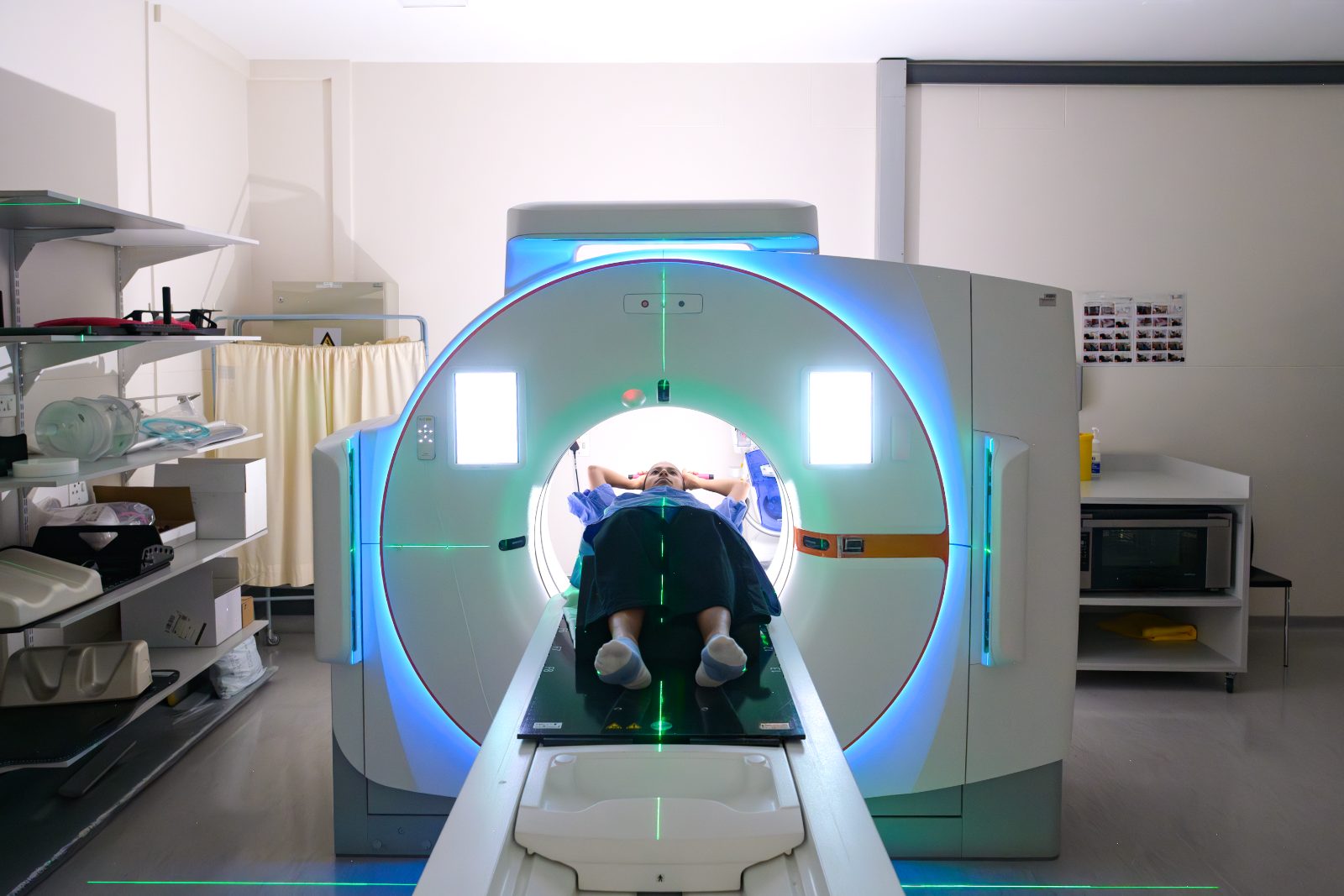
The system was trained on 24,000 abdominal CT scans, scans from patients later diagnosed with pancreatic cancer, paired with matched controls who were not. Crucially, the training set included scans taken at various points before diagnosis, some up to three years before the cancer became clinically apparent.
The model learned to recognize a constellation of subtle changes in the pancreatic tissue, ductal anatomy, and surrounding structures that precede diagnosis. Individually, each change sits within the range of normal variation. In combination, in specific spatial patterns, they appear to be early signatures of malignant transformation. In retrospective validation on held-out scans, the AI flagged cases on average three years before eventual diagnosis, scans that trained radiologists had reviewed at the time and judged normal.
The architecture is a convolutional neural network trained on three-dimensional CT volumes rather than flat slices, so it reads the pancreas as a spatial object and learns feature combinations across planes that no single axial image would reveal. The features it weights most heavily are not fully interpretable, the standard limitation of deep learning on images, but the validation indicates it is detecting something real and reproducible rather than overfitting to noise.
The proposal is not to use the AI as a standalone diagnostic. It is to run it as a silent second reader on the tens of millions of abdominal CT scans already performed each year for unrelated reasons, appendicitis, kidney stones, vascular imaging. Those scans exist; the model adds a pass that looks specifically for pancreatic changes that human attention, fixed on the primary question, would not prioritize.
The decisive caveat is that this is retrospective. Validating a model on scans from people already known to have developed cancer is necessary but not sufficient. The prospective trial, applying the model to patients whose outcomes are unknown and following them forward, is now enrolling, with a lower-dose version in development for resource-limited settings. FDA review has not begun. If the prospective data confirms the retrospective performance, the cost of running the algorithm on an existing scan is negligible; the cost of catching pancreatic cancer at Stage IV instead of Stage I is not.